Liquid Cooling in Next-Gen Data Centers: How Hardware Infrastructure Handles Modern Compute Heat
Liquid cooling is replacing traditional air cooling in modern data centers to efficiently manage extreme heat, lower energy costs, and power high-density AI hardware.
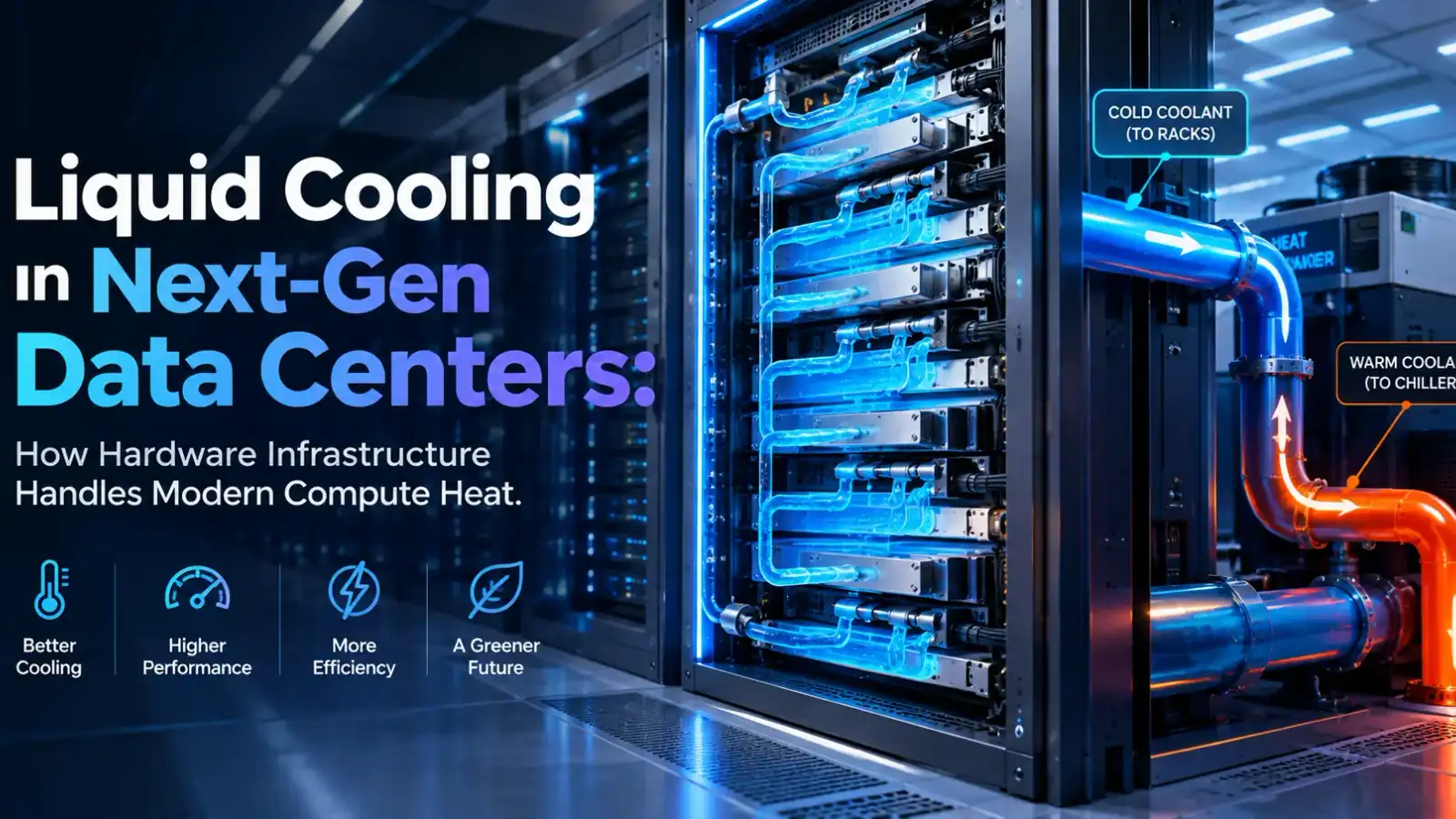
Picture a room packed with thousands of ultra-high-performance processors running non-stop. Every second, they process complex AI models, stream high-definition video, and handle millions of global web transactions.
The byproduct of all this massive computing power? Extreme, blistering heat.
For decades, data centers relied on massive air conditioning units and high-speed fans to blow cool air across server racks. But as modern chips push power consumption to unprecedented levels, traditional air cooling has officially hit a thermal wall.
Enter Liquid Cooling—the hardware infrastructure shift saving modern data centers from melting down.
Why Air Cooling Is No Longer Enough
The math behind traditional air cooling simply doesn't add up anymore.
Historically, standard enterprise server racks operated at a power density of 5 to 15 kilowatts (kW). Standard AC fans could easily move enough cold air to keep those components within safe operating temperatures.
    TRADITIONAL AIR COOLING           NEXT-GEN LIQUID COOLING
┌─────────────────────────────┐    ┌─────────────────────────────┐
│ High Fan Power Noise        │    │ Silent Heat Transfer        │
│ Limited to ~30kW / Rack     │ VS │ Handles 100kW+ / Rack       │
│ Air Insulates Heat          │    │ Liquid Conducts Heat 24x    │
└─────────────────────────────┘    └─────────────────────────────┘
Today, next-gen AI accelerators, GPUs, and multi-core CPUs draw thousands of watts per individual chip. Modern AI server racks now demand 40 kW to over 100 kW per rack.
Air is a poor thermal conductor; it cannot move heat fast enough to cool these concentrated hotspots. Without a new solution, these expensive processors automatically throttle their performance—or burn out completely.
The Core Technologies Behind Data Center Liquid Cooling
To handle modern compute heat, infrastructure engineers use two main types of liquid cooling systems:
1. Direct-to-Chip (Cold Plate) Cooling
This is currently the most popular method for retrofitting existing facilities.
• How it works: Sealed metal plates (cold plates) are mounted directly on top of heat-generating components like the CPU and GPU.
• The mechanism: A non-conductive fluid or treated water flows through tiny channels inside the plate, absorbs the heat directly at the source, and pumps it out of the server to a heat exchanger.
• The advantage: The liquid never actually touches the raw electronic circuitry, making it safe and easy to maintain.
2. Immersion Cooling
Immersion cooling is the most radical—and efficient—approach to thermal management.
• How it works: Entire server chassis are submerged completely into specialized tanks filled with dielectric (electrically non-conductive) fluid.
• The mechanism: The fluid absorbs heat directly from every single resistor, memory stick, and processor. Warm fluid rises to the top, gets pumped out to a heat exchanger, cools down, and cycles back into the tank.
• The advantage: It completely eliminates fans, reduces noise to zero, and provides maximum heat dissipation.
Key Advantages of Switching to Liquid Cooling
Adopting liquid cooling is not cheap, but the long-term infrastructure benefits are game-changing:
| Metric | Traditional Air Cooling | Advanced Liquid Cooling |
| Thermal Conductivity | Low (Air acts as an insulator) | 24x to 25x higher than air |
| Energy Consumption | High (Fans run continuously) | Up to 40% reduction in cooling energy |
| Max Rack Density | ~30 kW limit | 100 kW to 900+ kW per rack |
| Hardware Lifespan | Lower (Thermal stress from hotspots) | Higher (Constant, stable temperatures) |
Massive Energy Savings
Air chillers and high-RPM fans consume up to 40% of a data center’s total electricity bill. Liquids transfer heat much more efficiently than gases, allowing data centers to cut their overall power consumption dramatically.
Reduced Carbon Footprint and Water Usage
Many modern closed-loop liquid systems recycle their cooling fluids, requiring zero continuous water waste. Furthermore, the captured hot water can be reused to heat surrounding municipal buildings or industrial processes during cold months.
The Challenges of Implementing Liquid Cooling
Despite its overwhelming benefits, migrating a data center to liquid cooling comes with distinct obstacles:
• High Initial Capital Expenditure (CapEx): Retrofitting an existing air-cooled facility requires buying new plumbing, pumps, coolant distribution units (CDUs), and specialized tanks.
• Maintenance Complexity: Technicians working on immersion systems must lift dripping server blades out of fluid tanks using specialized cranes, requiring new operational procedures.
Fluid Costs & Leak Risks: Dielectric fluids are expensive, and any plumbing leak inside a multi-million-dollar server room requires advanced detection and safety systems.
Final Thoughts
The demand for high-density computing isn't slowing down. As artificial intelligence, autonomous systems, and advanced simulations scale up, processing hardware will only continue to run hotter.
Liquid cooling has evolved from a niche technology used by gaming enthusiasts to an essential pillar of global cloud infrastructure. Data centers that make the leap to liquid thermal management today will power tomorrow's tech innovations smoothly, efficiently, and sustainably.
0 COMMENTS
Be the first person to share a thought.